

TUCSON’S CEMETERIES: PART I
a melding of Peoples
History, Tucson Arizona ● Chuk Son ● Santa Cruz River Valley ● Huhugam ● Akimel O’odham
Tohono O’odham ● Pimería Alta region ● Father Eusebio Francisco Kino ● Sobaipuri O’odham
La Misión de San Xavier del Bac ● La Misión de San Agustín de Oyaur
San Cosmé y Damián del Tucsón ● Father Francisco Garcés
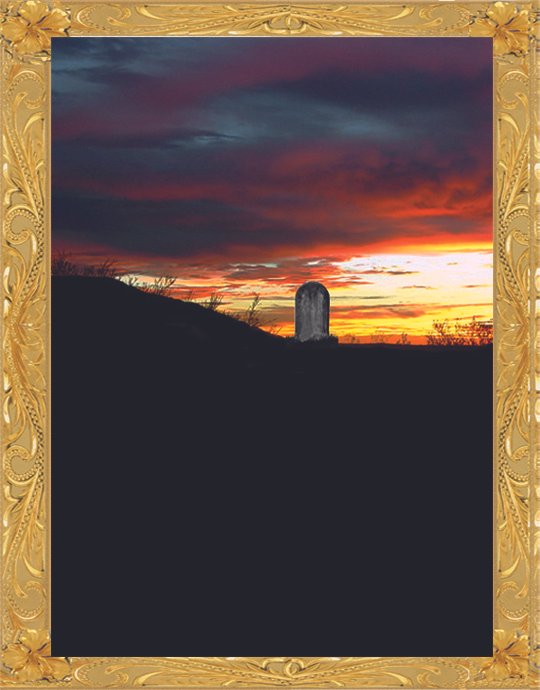
Except for the addition of the tombstone, this photo displays a sunset from my back lānai in Tucson, Arizona. It sits in the frame designed for the Natalie Seachrist Visionary Hawaiian Mysteries by Art Director Yasamine June. This two part article was researched and written during the first couple of years after moving to Tucson when I wrote a variety of articles for a local office of a national real estate company. The research I performed was a wonderful way to learn of the many resources available to me in the city…let alone the knowledge I gained about the history of several parts of the southwestern United States. . .
Tucson and Her Cemeteries
Part I
The growth of any city necessitates periodic review of accommodations for the dearly departed. In those few instances when a city is strategically designed and built, its founders may have the chance to plan the location of its cemeteries. Unfortunately, such exacting opportunities seldom present themselves and initial burials are quick and casual, often without formal religious ceremonies. This was especially true in Arizona, where the climate exacerbated the rapid decomposition of bodies.
Having been under the sovereignty of several nations, the history of Tucson, Arizona, is complex. Like most cities, the community has grown from villages of indigenous peoples who settled along the banks of area rivers, streams, and water holes. Like the changing course of a river through time, there have been shifts in the names and locations of many of its components: Multiple transliterations and explanations for the origins of the name “Tucson” have been offered; area military encampments have changed title and locale; and, with urban growth, cemeteries have come and gone with varying degrees of official status and location.
S-CUK SON TO CHUK SON TO TUCSON:
The Early Years
From ancient Native Americans, to those of us who have sojourned here more recently, people have lived in the rich Santa Cruz River Valley(1) for over 10,000 years. Burial sites in the Sonoran high desert indicate the Huhugam(2) [probable ancestors of the Akimel O’odham (“River People”) and Tohono O’odham (“Desert People”) resided in the area from about 300 to 1500 Common Era.
From the sixteenth century, Spanish conquistadors and missionaries journeyed throughout the Pimería Alta region of Sonora, Mexico, and Southern Arizona. Their positive reports of the fertile river valley and the productive O`odham farmers who employed extensive irrigation ditches for cultivating maize, cotton, beans and other staples, encouraged further exploration and colonization by the Viceroyalty of New Spain. In 1692, Father Eusebio Francisco Kino, a Roman Catholic Jesuit priest, visited the area to map the territory and determine sites for establishing missions. Shortly, a small one was established at Bac south of Tucson(3) on a settlement of the Sobaipuri O’odham people. Eventually, this would become the famous La Misión de San Xavier del Bac, named for the co-founder of the Roman Catholic Jesuit Order [the Society of Jesus].
LA MISIÓN DE SAN AGUSTĺN DEL TUCSÓN (1692-1828)
In his drawings and maps of 1695, Father Kino noted two rancherías de visita (“daughter” or satellite missions) north of Bac along the Santa Cruz River. San Agustín de Oyaur(4)was on the east side of the river. And, to the west of the river and a bit south, he refers to the second as San Cosmé y Damián del Tucsón, consisting of four villages of the O’odham.
The foundation of this second satellite mission was laid near the Sobaipuri village of Chuk Shon(5). Translated as “at the foot of the black mountain,” the village is believed to be the origin for the naming of the city of Tucson. Located below Sentinel Peak [now “A” Mountain], the small mission provided the first European cemetery in the Tucson area.
Following the 1767 expulsion of Jesuit priests(6), Father Francisco Garcés and his fellow Franciscan priests were charged with overseeing the mission at Bac and its northern satellites. Until missionaries were permanently assigned, these communities received the part-time attention of visiting priests. Their work focused on periodically performing church rituals and introducing new crops and livestock to the local farming culture.
In 1768, expansion of the Tucson mission was begun. Through the labor of the O`odham, a mission residence with lookout towers was completed in 1771, with a chapel being added the following year. By 1793 they had completed construction of an adobe brick church and two cemeteries for the mission they renamed la Misión de San Agustín de Tucsón. The mission was abandoned in 1828. A sojourner en route to California’s gold fields in 1849 recorded seeing only the remains of an old mission and orchard. In the 1950s, the land was turned into a city garbage dump. Today there is a walled mission garden that is open to the public.
* * * * * * * * * *
(1) The Spanish initially named the river, el Rio de Santa Maria.
(2) A new transliteration of Hohokam.
(3) This mission remained active until it was replaced by the famous Misión del San Xavier del Bacwhich was begun in 1756.
(4) Alternatively spelled “Oiaut” and “Oyaut,” the location of this early satellite mission is only described as being a few miles north of that of la Misión San Cosmé y Damián de Tucsón. It may have been wholly abandoned during the numerous attacks of the Apache.
(5) In addition to S-cuk Son, oral traditions and early historical records have noted numerous possible spellings for the original the name of Tucson, including: Chuk son, Chukson, or Chukeson; Stjukshon, Shook-Shon; Cuk Son; Slyuk-Son; Styuk-Zone; Toixon; Tucsiom, Tugson; Teuson; Tupson; and the diminutive Tucsonito. By 1847, the town had become generally recognized as Tucson.
(6) In June of 1767, King Charles III of Spain (followed by most of Europe's other royal houses) ordered the expulsion of all Jesuits from his kingdom (including Spain's colonies and the confiscation of their land holdings. Subsequently, Jesuit monks and priests were arrested throughout the world and shipped to Rome. Their lands were sold or given to missionaries of the Franciscan Order.
I hope you have enjoyed this introduction to some of Tucson’s history…to learn more, go on to Part II…
Aloha, Jeanne
